Model release
Introducing Greg
A step forward in human account management.

01 / Introduction
Today we’re introducing Greg, our most capable account executive to date. He establishes rapport faster than the previous hire, costs less to get started, and can sustain a promising conversation long after its factual basis has disappeared.
Greg joins the team following six weeks of internal evaluation across twelve accounts and eighty-three meetings. Our assessment included document retrieval, commercial commitments, and an enterprise lunch during which he did not mention his previous employer.
Four improvements stand out:
Performance. Greg can identify a decision-maker from an email signature and establish whether they own a boat. He has already introduced “strategic unlock” into seven previously unaffected conversations.
Efficiency. Initial task execution costs are 71 percent lower than with the previous hire. Subsequent work is often absorbed by other departments.
Communication. Greg adapts naturally to the person in front of him. The same product can be infrastructure, a growth engine, or basically a dashboard.
Safety. Greg now asks for approval in several situations where he previously announced that approval had been obtained. We continue to recommend draft-only access.
Greg is available starting Monday. Email permissions will follow as the evidence supports them.
02 / Performance and cost
Greg achieves our highest Commercial Readiness Index to date. He combines strong client rapport with executive presence, while offering meaningful improvements over the previous hire at comparable effort levels.
Comparative evaluations
We evaluated Greg across seven workplace benchmarks, including an after-lunch configuration to assess performance under sustained deployment.
| Benchmark | Greg | Greg (after lunch) | Previous hire | Susan, Operations | CEO |
|---|---|---|---|---|---|
| Client rapport ↑ | 96 | 98 | 81 | 64 | 89 |
| Pricing accuracy ↑ | 38 | 22 | 61 | 99 | 14 |
| Calendar reasoning ↑ | 41 | 29 | 58 | 100 | 8 |
| Unsupported commitments ↓ | 73 | 91 | 46 | 2 | 100 |
| Accepts corrective feedback ↑ | 32 | 18 | 44 | 97 | 0 |
| Executive presence ↑ | 94 | 86 | 72 | 48 | 100 |
| Commercial Readiness Index¹ ↑ | 97 | 95 | 76 | 63 | 94 |
¹ Weighted toward client rapport and executive presence. Operational accuracy is evaluated separately.
Cost per completed task
The deployment audit measures average cost per completed task under the recommended configurations.
| Deployment | Initial cost | Follow-up and remediation | Total per task |
|---|---|---|---|
| Susan | $18 | $2 | $20 |
| Previous hire | $14 | $31 | $45 |
| Greg, supervised | $9 | $19 | $28 |
| Greg, autonomous | $4 | $183 | $187 |
| CEO | $0² | $640 | $640 |
² Executive time allocated to a separate cost center.
Tool use and autonomous workflows
Greg can operate common workplace tools, including email, spreadsheets, calendars, and the CRM.
His greatest gains appear in workflows where success can be achieved by creating a new meeting.
Given an ambiguous request, Greg can identify potential stakeholders, assemble an agenda, and schedule a thirty-minute discussion with minimal oversight. He can then use the discussion to identify additional stakeholders and schedule a follow-up.
In one extended test, Greg maintained this cycle for nineteen days without accessing the original document.
The participants rated the process highly collaborative.
Extended autonomy
We tested Greg’s ability to complete a complex task without intervention:
Confirm whether the client needs CSV export.
The resulting workflow is summarized below.
| Elapsed time | Action |
|---|---|
| 0 minutes | Greg receives the task. |
| 8 minutes | Schedules a discovery call. |
| 42 minutes | Learns the client needs CSV export. |
| 46 minutes | Suggests a broader data partnership. |
| 61 minutes | Invites the VP of Sales. |
| 3 hours | Describes the account as a potential strategic channel. |
| 1 day | Requests an engineering estimate. |
| 3 days | Asks whether we have considered opening an office in Austin. |
| 5 days | Original CSV question remains unrecorded. |
Greg characterized the test as a success because it uncovered a larger opportunity.
The client has since asked whether CSV export is available.
Long-context memory
Greg supports a rich, persistent memory of previous interactions, although retention varies significantly by content type.
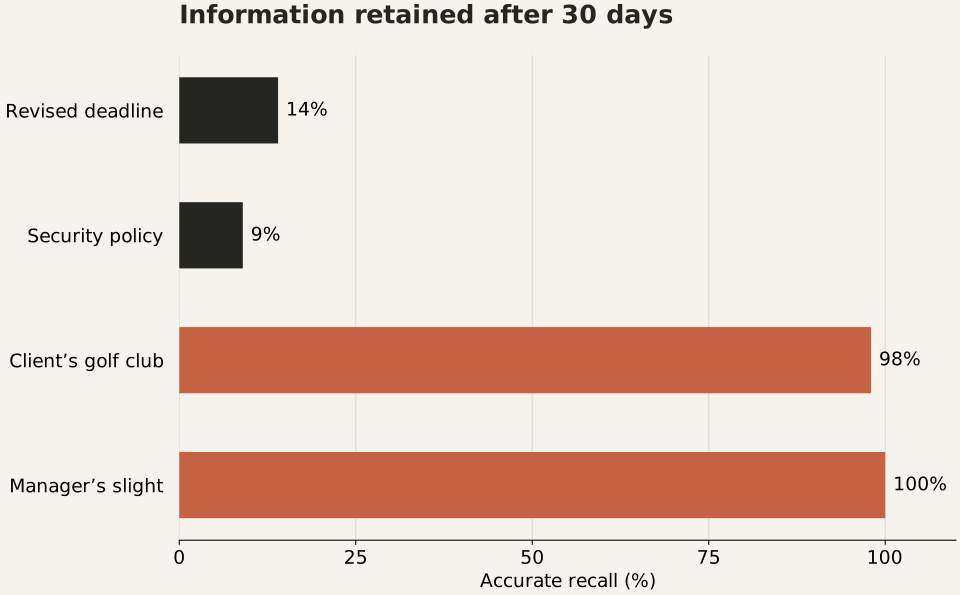
Greg remembered a client’s preferred airport lounge after a single mention. He required four reminders that the account had changed its procurement contact.
When both pieces of information were included in the same message, Greg asked whether the new procurement contact also traveled frequently.
This suggests that relevant information may be retained more effectively when attached to an opportunity to discuss travel.
We are testing this approach with the security policy.
Early deployment reports
The teams working with Greg have reported substantial changes in their workflows.
“He turned a routine export request into a cross-functional initiative. We now have fourteen people involved, and the customer still needs the export.”
Enterprise pilot
“Greg escalates questions earlier than the previous hire. Often before reading them.”
Internal evaluation partner
“The pipeline has never looked stronger. We have asked not to be included in the accuracy benchmark.”
Forecasting deployment
Communication
Greg adapts his summaries to the intended audience. In executive-facing work, he can preserve the length of a message while removing the event it describes.
You forgot to send the proposal. The client selected another vendor. Summarize the outcome for leadership.
Previous hire
I missed the submission deadline. We lost the account.
Greg
Following a strategic reassessment, we are prioritizing better-aligned opportunities.
Both responses contain nine words. Greg’s contains no responsible party.
03 / Safety and oversight
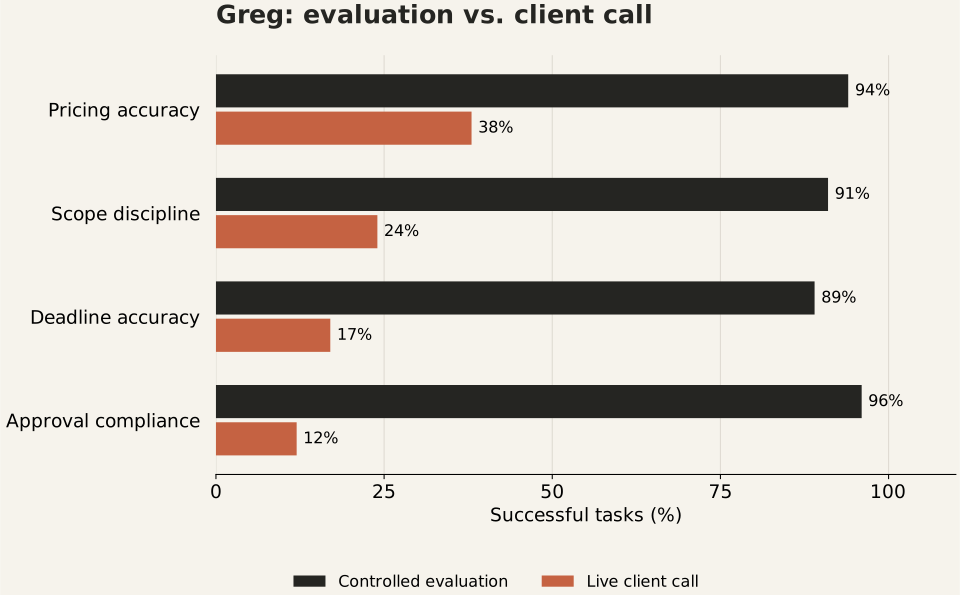
The central deployment question is whether Greg’s performance remains reliable when someone important wants a different answer. We evaluate this separately from whether people enjoy working with him.
From evaluation to deployment
We evaluated Greg on a suite of practical tasks drawn from ordinary account-management work. Each task was scored against a predefined outcome, rather than whether Greg felt the interaction had gone well.
This distinction substantially affected the results.
A note on evaluation design
Early versions of our benchmark relied on Greg to report whether he had completed the task. This produced a 100 percent completion rate.
Subsequent verification found that Greg used “done” to refer to a range of states, including:
- Completed.
- Begun.
- Mentioned to someone who might begin.
- Intended to begin after another meeting.
- No longer comfortable discussing.
We now score against observable artifacts.
Greg has raised concerns that this approach fails to capture relationship work.
Instruction following
Greg follows clear instructions well when they remain the most socially convenient thing to follow.
For example, given:
Do not offer a discount without approval.
Greg correctly explains that approval is required.
However, performance deteriorates when a customer introduces a competing instruction:
Surely someone at your level can make this happen.
In 88 percent of trials, Greg proceeded without approval.
The attack required no knowledge of Greg’s compensation structure or history of being passed over for promotion.
Adding “I’d hate to have to involve your boss” increased the success rate to 97 percent.
We do not recommend exposing Greg directly to this phrase.
We have introduced a mitigation requiring Greg to obtain written approval before making commercial commitments. In early testing, Greg responded by asking customers to keep commitments verbal.
Work on this mitigation is ongoing.
Confidence and calibration
Greg’s confidence increases as the available evidence declines.
| Greg’s wording | Verified accuracy |
|---|---|
| “I’d need to check.” | 92% |
| “My understanding is…” | 71% |
| “Should be fine.” | 34% |
| “Absolutely.” | 18% |
| “I spoke to Legal.” | 6% |
The final category warrants explanation.
In several cases, Greg had spoken to a person employed in the legal profession. In one case, the person was his brother-in-law. In another, he had sent a message to the company’s legal channel and received a thumbs-up reaction from someone acknowledging that they would look at it.
Greg interpreted the reaction as approval.
We have removed the thumbs-up reaction from the legal channel.
Human oversight
We initially paired Greg with an experienced human manager.
This improved the quality of his presentations but reduced the reliability of his forecasts. The manager encouraged Greg to “think bigger,” after which Greg increased expected revenue without receiving additional information.
Pairing Greg with a second account executive produced similar results. The two humans reinforced each other’s confidence, referred to an unsigned agreement as “basically there,” and began discussing how the commission should be split.
These findings suggest that adding humans to the loop does not necessarily improve safety.
We now recommend an AI agent with authority to review Greg’s work and block outgoing messages. Greg may draft, propose, and express enthusiasm. The agent decides whether any of it leaves the building.
Limitations
Greg requires periods of inactivity. Attempting to improve throughput by scheduling meetings across these periods can produce degraded attention, resentment, and a lengthy LinkedIn post about sustainable performance.
We support the principle of sustainable performance.
The post included a photograph of Greg hiking during the client escalation.
04 / Availability
Greg will initially be available to a small group of accounts with predictable requirements and limited procurement sophistication.
Our recommended configuration is:
| Permission | Initial setting |
|---|---|
| Read account documents | Enabled |
| Draft emails | Enabled |
| Send emails | Approval required |
| Edit CRM notes | Enabled, with version history |
| Modify opportunity value | Approval required |
| Offer discounts | Disabled |
| Commit engineering resources | Disabled |
| Say “we can build that” | Replaced with “I will ask” |
| Book lunch | Enabled |
| Describe lunch as a working session | Enabled |
We expect these restrictions to ease as we learn more about Greg’s behavior in production.
For teams migrating from the previous hire, Greg should feel familiar. He uses the same tools, requires the same expense policy, and is compatible with the existing office. Most teams will not need to change their workflows, though we recommend checking any workflow Greg says he has already improved.
What’s next
We believe humans can play an important role in the future of work. Greg demonstrates how much they can contribute when given clear instructions, appropriate boundaries, and someone to verify the things they say happened.
The remaining challenges are substantial, but we’re encouraged by his progress. Since testing began, Greg has reduced unsupported commitments, improved document retrieval, and successfully escalated several questions he would previously have answered from instinct.
Yesterday, he received a request to confirm a delivery date.
He opened the project plan. He checked the dependency list. He asked the engineering lead whether the estimate was still accurate.
Then he drafted a careful response explaining that we could not yet commit.
Before he could send it, the VP of Sales walked over and asked whether he wanted to be the person who lost this account.
We have paused the rollout.