News
OpenAI Releases Hundreds of Mathematical Results, Still Unable to Make Revenue Minus Expenses Come Out Positive
Researchers identified a gap at the step labeled “Obviously.”
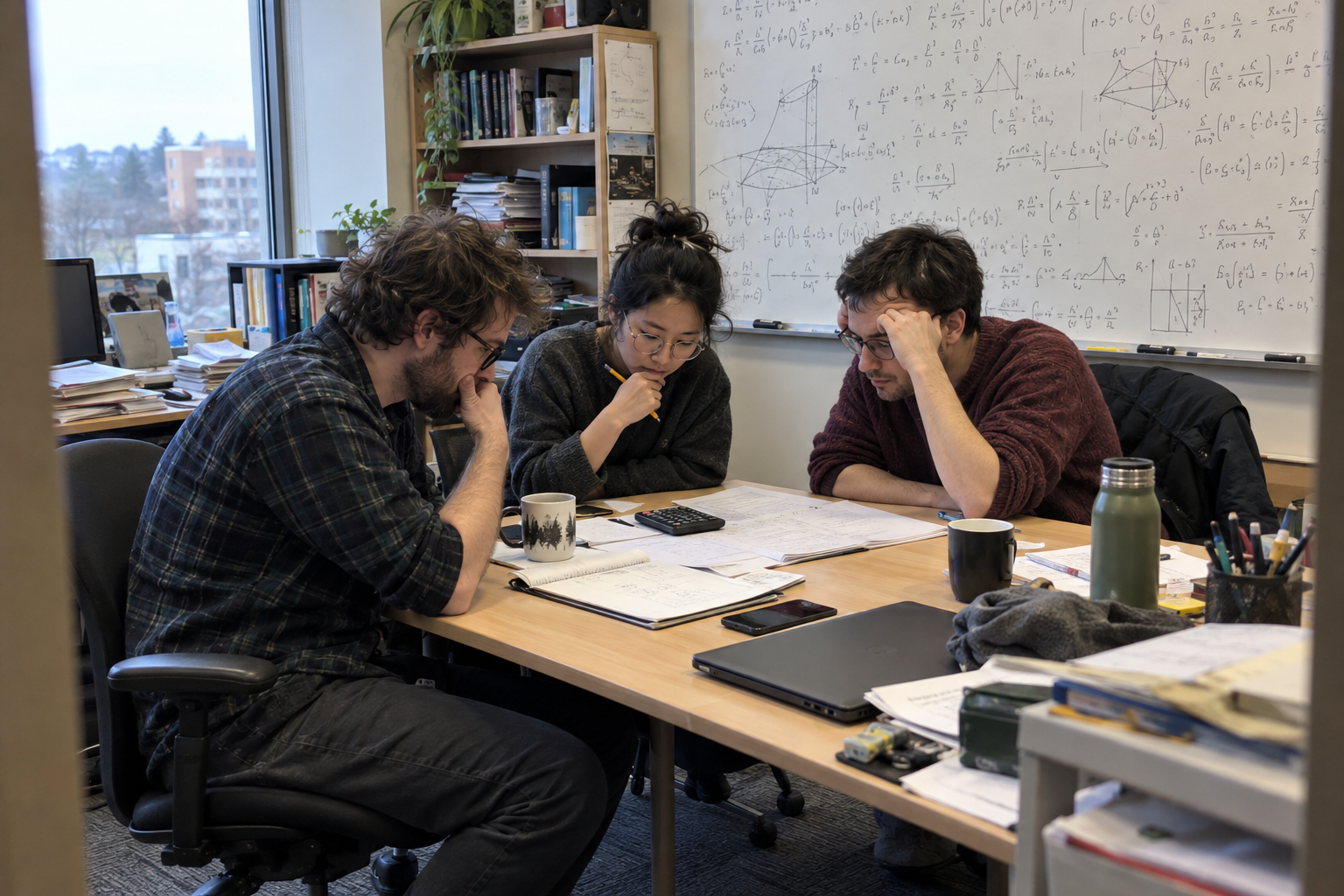
SAN FRANCISCO—Following its release of hundreds of AI-generated mathematical results, OpenAI announced Friday that its most advanced reasoning system remained stumped by a two-step problem involving the amount of money a company receives and the amount it spends.
Researchers described the problem as unusually resistant to scaling, noting that every attempt to solve it using a larger computer had changed one of the numbers in the wrong direction.
“We can get the model to perform the subtraction,” said company spokesperson Daniel Voss. “The challenge is getting it to arrive at a result we can announce.”
The difficulty emerged during testing of a proposed profitability proof, which initially appeared promising until an employee noticed that the argument began with the words “Assume electricity is free.” A revised version removed that assumption but required all employees to be independently wealthy.
Both proofs have been returned to the research team.
According to Voss, the company’s recent mathematical work demonstrates an ability to reason across highly abstract domains. Profitability, however, presents additional complications, including invoices, due dates, and counterparties who insist that numbers continue to mean the same thing after a presentation ends.
“Pure mathematics gives you time to develop an argument,” Voss said. “Our landlord wants the whole thing by the first.”
The company has assembled a dedicated team to investigate whether expenses must always be subtracted from revenue, or whether the order of operations permits executives to describe the revenue for several minutes before advancing to a different slide.
An early breakthrough allowed the team to produce a positive number by excluding the cost of training models, running models, employing the people who build models, and acquiring the equipment on which the models run. The result was independently verified by three people preparing the same investor deck.
Researchers cautioned that extending the proof to a company that actually operates would require further work.
“We have established that a profitable OpenAI can exist,” said research lead Dr. Mara Bell. “We’re now trying to establish that it can exist in the same building as this one.”
To accelerate progress, engineers gave the model access to a calculator. The calculator was subsequently removed after producing the same answer without acknowledging the transformative potential of the technology.
The team then attempted a proof by induction: if investors had funded the company last year, and investors funded it this year, researchers argued, investors would fund it every year. Reviewers identified a gap at the step labeled “Obviously.”
A separate approach involving imaginary numbers was abandoned when the utility company confirmed it accepted only real money.
Despite these setbacks, officials said the company had made significant progress distinguishing revenue from other quantities. A mandatory training session now requires employees to sort cards labeled “customer payment,” “valuation,” and “someone saying this could be enormous” into three separate piles.
Voss declined to disclose the pass rate.
The company has also convened a panel of outside mathematicians to review the profitability argument. Members reportedly requested a complete list of expenses, prompting OpenAI to ask whether they could first sign a statement agreeing that the work was historically important.
In the meantime, the research team has restricted the problem to a simplified case involving a single customer, a single subscription payment, and a single response. Even under these conditions, the model repeatedly suggested answering the customer more cheaply, a recommendation researchers classified as insufficiently ambitious.
The next experiment will investigate whether serving an infinite number of customers can compensate for losing money on each one. Engineers have already requested a larger cluster to explore the question.
At press time, OpenAI had announced a breakthrough after its model successfully proved that solving the profitability problem would require additional funding.